‘My characters were strong children who could always win. They didn’t need adults to win for them; they could do it themselves. And I tried to put in a joke at the end of the story. I learned to write for children by reading and talking to them. I was taught to write by children.’ Joy Cowley

The story of My Tiger has been around since the 1980s—with tigers by at least three different illustrators. Can you tell us about its beginnings?
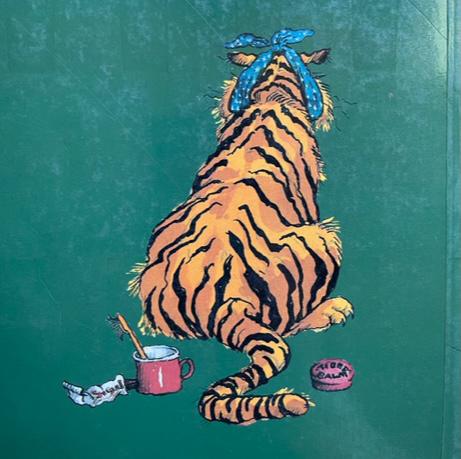
In my day, children called the school dentist the murder house, which gave me thought for this story. It originated from my days writing for the School Journal. Robyn Belton drew the first tiger for the School Journal. It was beautiful. I still have a copy of this. She also illustrated a school reader version of the story that came a few years later. At the very end of that version, the tiger was just sitting with some spectacles hanging from his jaw!
Robyn Belton: ‘I think it was My Tiger that really started our long and richly rewarding collaboration. We both loved the humour of this story and from then on we were constantly working together. Such is Joy’s skill, this story has a great beginning, great middle and brilliant ending. And all in such a short story!’

Do you think people will be nervous of such a grizzly end?
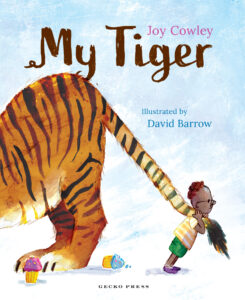
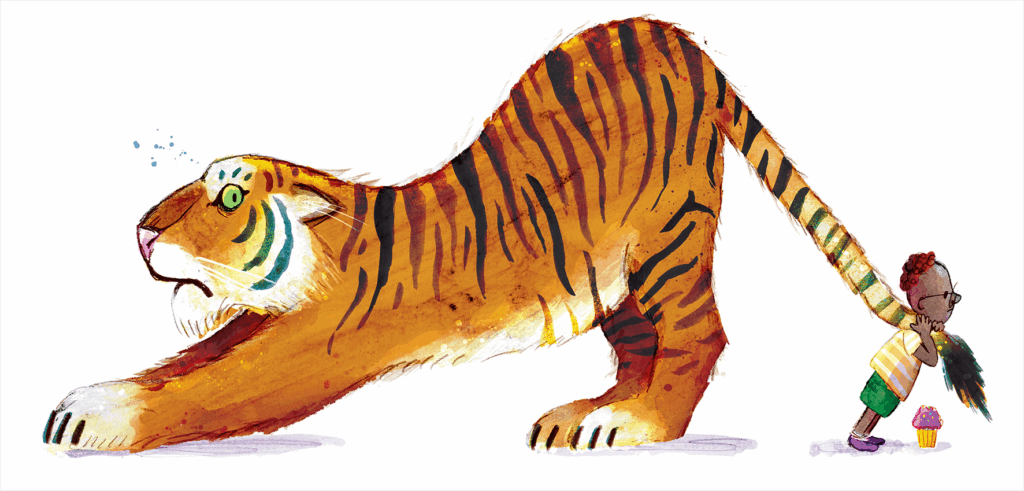
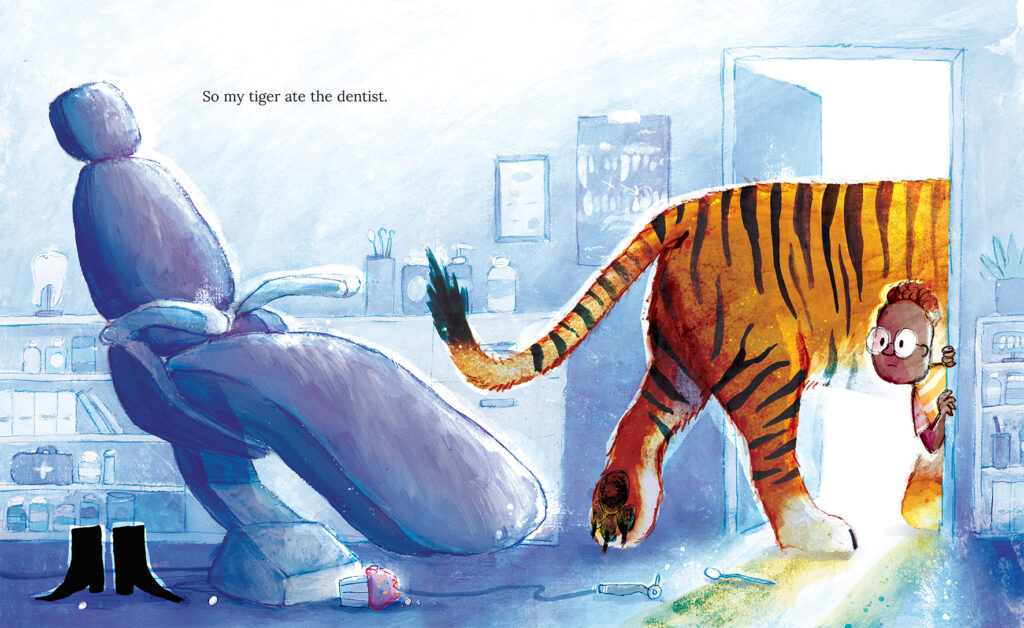
David Barrow’s new illustrations for My Tiger—which are lovely—just give you the impression of what happens. When you get to the end of the book, there’s nothing gruesome, just a pair of boots.

This is the first time the story has been published as a full 32-page picture
book. Did you change anything?

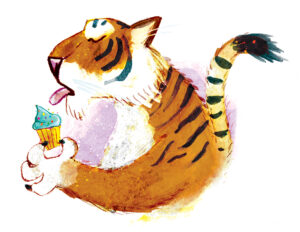
David is very clever with the way he manages to fill out the book. I had initially said to him, well I don’t think there will be a book because the story isn’t long enough. But he wanted to have a little bit of fun at the beginning with the tiger eating a lot of cake. The story really doesn’t need language; it just needs pictures. And he did it beautifully.
When did you start writing? Was it when you started working on the school reader editions?
I started writing for children in my last year at school. My parents were poor and they wanted me to leave school to earn some money, but my teacher convinced my parents to let me stay. In the afternoons, after school, I ran a children’s page for the Manawatu Daily Times. This was my first experience at writing for children. When I was about 21 or 22 years old, I married then had four children in four and a half years. I had stories everywhere around the house, and I started writing for the School Journal.
I was taught to write by children. I think that’s so important. I started using words that were readily ‘decodable’ by young children. For example, I would use the word ‘giggle’ instead of ‘laugh’ because it’s hard for them to spell out ‘laugh’ but if you use ‘giggle’ you can go ‘oh yes that’s giggle’. It was important the story wasn’t written from an adults’ view.
My characters were strong children who could always win. They didn’t need adults to win for them; they could do it themselves. And I tried to put in a joke at the end of the story. I learned to write for children by reading and talking to them. If they didn’t like to the story, I scrapped it. I’ve learned so much from the children themselves.
Is it true you’ve written more than 1000 books?
I have!
The ‘murder house’ at Government House
A funny true story relating to this book – some years ago I was being given an award at Government House in Wellington. There were five of us receiving the same award and we had to give a talk about what we did. Everyone said much the same thing, which seemed a bit boring. When it was my turn, I said, well I’m going to tell you a story instead, and I told them the story of My Tiger. When I got to the end, there was a great roar and all in the audience, with their precise language and their beautiful costumes, nearly fell on the floor with laughter. They had all had experience of the ‘murder house’. The next morning, the newspaper headline was ‘Cowley Lifts the Roof off Government House.’
Illustrations by David Barrow (unless otherwise attributed).