


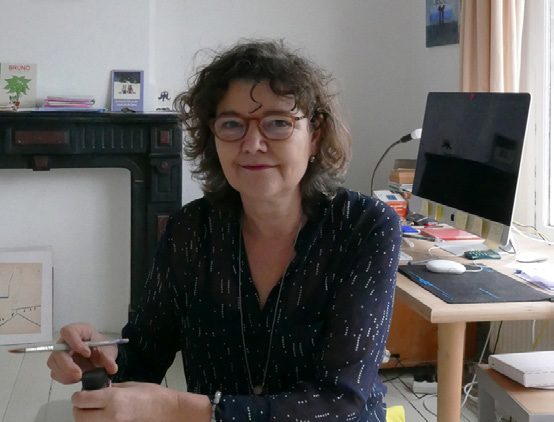


Catharina Valckx has written and illustrated over 40 books and been nominated five times for the Astrid Lindgren Memorial Award. Her books are published in more than 17 languages and have won numerous awards.
Many of your books are about small, everyday happenings—a lost sock, finding shelter from rain—but this one has a big theme of what makes a life worth living. What made you take on this big story? (Or is it actually just the same size as the others?)
It’s true, this book is quite different from my others. It started with a suggestion from a producer I work with that I write a screenplay for an animated movie. Her request overwhelmed me. I thought, “Huh? A story for a one-hour film?! I’ve never written anything that long!” But, of course, you can’t refuse such an amazing offer.
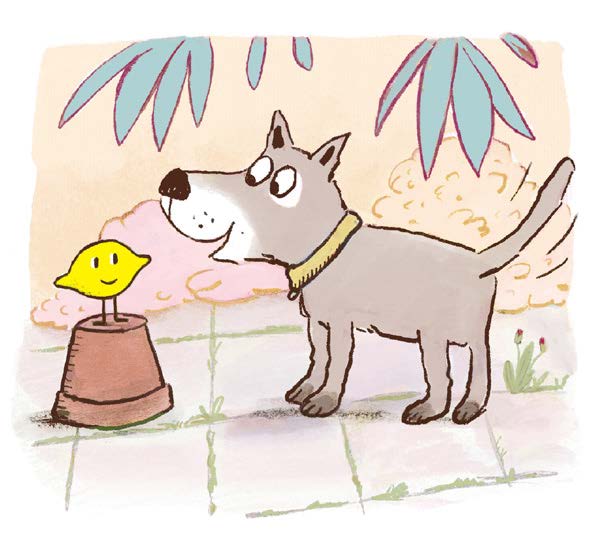
Right away I thought of Edith and the little lemon, characters I’d had in mind for a while. I started thinking about a story that could go on for an hour without getting boring or too complicated. I thought the characters could go on a quest for an important matter—something so important that you really want it to succeed.
I wanted to work freely so I told the producer that I would make a book first, on my own, and they could adapt it for film later, if they wanted to. (And it’s going to happen, we just signed the contract!)
What would you like readers to take from reading Edith?
The story of Edith makes us think about life, the different phases we go through from childhood to old age, and the beauty of the whole. These phases are so different, each has charms and challenges, and makes no sense without the others. Also, one day life comes to an end—and we wouldn’t want it not to.
I tried not to make the story too heavy, though. Squirt, the little lemon, is very playful, and I came up with some funny fantasy characters like the grumpy grandfather clock and the wild boat. Most of all, Edith is a courageous, optimistic little girl (and she has a sweet dog 🙂 ).
Edith has magic, fairies and a gnome, but a contemporary heroine who rides a skateboard—do you see it as a fairy tale?
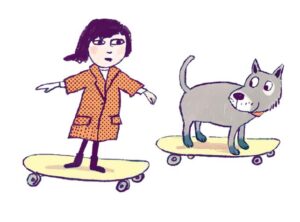

I like to spark children’s awareness of things changing with time, an awareness of history. Putting old elements in a modern world makes it very tangible. A wonderful thing about fairy tales is that they set up a fantasy world. They don’t pretend not to. Every child knows that. I loved fantasy as a kid (especially gnomes and witches).
Your books often feature ‘things’ as characters and, in this book, Edith herself is given the power to animate objects. Are the object characters in your books different from the animal or human characters or are they all the same?

Your books are very popular in France. We’ve seen a Marie Claire feature about you with a full-page photo titled ‘Queen Catharina’! Why do you think children connect with your books so strongly?
It’s difficult for me to answer this one. I write quite intuitively. But well . . . I give life to characters that they (and I) could possibly love. Characters that are not perfect, with their eventual worries and faults, but with a lot of kindness. Storytellers have two well-known weapons: humour and suspense. Also, I write with a lot of natural dialogue which makes reading aloud playful, like a theatre play, and brings the characters to life.
Are you attracted to particular kinds of characters?
It’s not something I decide logically, or even consciously. I think I like characters that aren’t perfect. A particular kind of character turns up often. They are like a child: naive, enthusiastic, altruistic, tolerant—fundamentally nice. They are open to friendship and to warm contact.
Are there themes you like to write about in your books for younger readers?
Friendship, which goes with tolerance and acceptance of differences. Sometimes, loneliness turns up. Characters have very frank relationships. In my books, there is no pettiness. There is a nice atmosphere. I describe the world as I would like it to be, as a possibility. There are, of course, bad guys, but I always defuse them quickly. I want to write comforting books, probably because I found the world quite scary when I was a child.
The other theme that matters to me is the love of nature in its diversity and beauty, in all seasons.
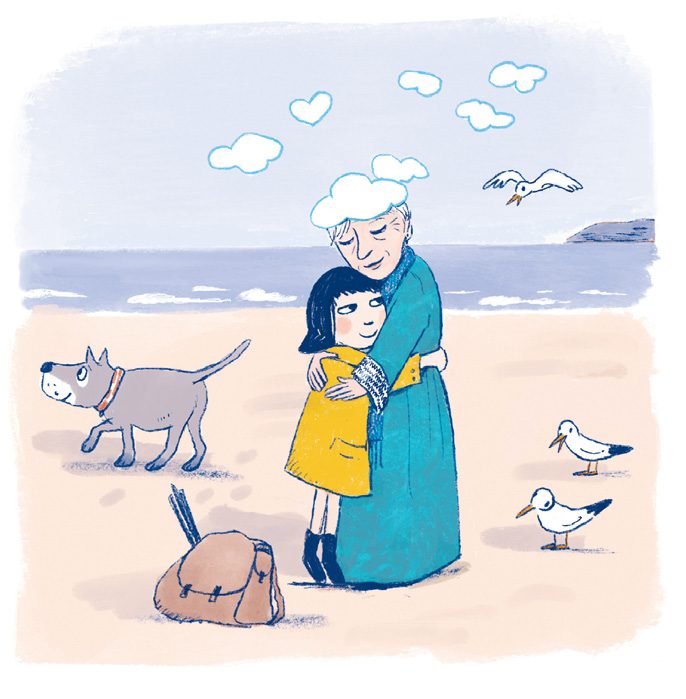

First I made sketches on paper, researching Edith’s appearance, especially, and her dog. The super simple look of the little lemon was obvious from the start. Then I made all the illustrations on an Apple Pro tablet, with an Apple pencil and the help of the incredible app Procreate.
Illustrations © Catharina Valckx from Edith